Fix kernel-doc warning:

../kernel/rcu/tree.c:959: warning: Excess function parameter 'irq' description in 'rcu_nmi_enter'

Fixes: cf7614e13c ("rcu: Refactor rcu_{nmi,irq}_{enter,exit}()")
Signed-off-by: Randy Dunlap <rdunlap@infradead.org>
Cc: Byungchul Park <byungchul.park@lge.com>
Cc: Joel Fernandes (Google) <joel@joelfernandes.org>
Signed-off-by: Paul E. McKenney <paulmck@kernel.org>
The ->grpnum field in the rcu_node structure contains the bit position
in this structure's parent's bitmasks, which is not the CPU number.
This commit therefore adjusts this field's comment accordingly.

Signed-off-by: Wei Yang <richard.weiyang@linux.alibaba.com>
Signed-off-by: Paul E. McKenney <paulmck@kernel.org>
The ->grplo and ->grphi fields store the lowest and highest CPU number
covered by to a rcu_node structure, which is not the group number.
This commit therefore adjusts these fields' comments to match reality.

Signed-off-by: Wei Yang <richard.weiyang@linux.alibaba.com>
Signed-off-by: Paul E. McKenney <paulmck@kernel.org>
Because gp_max is protected by root rcu_node's lock, this commit moves
the gp_max definition to the region of the rcu_node structure containing
fields protected by this lock.

Signed-off-by: Wei Yang <richard.weiyang@linux.alibaba.com>
Signed-off-by: Paul E. McKenney <paulmck@kernel.org>
The count and scan can be separated in time, and there is a fair chance
that all work is already done when the scan starts, which might in turn
result in a needless retry.  This commit therefore avoids this retry by
returning SHRINK_STOP.

Reviewed-by: Uladzislau Rezki (Sony) <urezki@gmail.com>
Signed-off-by: Peter Enderborg <peter.enderborg@sony.com>
Signed-off-by: Paul E. McKenney <paulmck@kernel.org>
Coccinelle reports a warning

WARNING: Assignment of 0/1 to bool variable

The root cause is that the variable lastphase is a bool, but is
initialised with integer 1.  This commit therefore replaces the 1 with
a true.

Signed-off-by: Jules Irenge <jbi.octave@gmail.com>
Signed-off-by: Paul E. McKenney <paulmck@kernel.org>
Currently, lockdep_rcu_suspicious() complains twice about RCU read-side
critical sections being invoked from within extended quiescent states,
for example:

	RCU used illegally from idle CPU!
	rcu_scheduler_active = 2, debug_locks = 1
	RCU used illegally from extended quiescent state!

This commit therefore saves a couple lines of code and one line of
console-log output by eliminating the first of these two complaints.

Link: https://lore.kernel.org/lkml/87wo4wnpzb.fsf@nanos.tec.linutronix.de
Cc: Peter Zijlstra <peterz@infradead.org>
Cc: Ingo Molnar <mingo@redhat.com>
Cc: Will Deacon <will@kernel.org>
Signed-off-by: Paul E. McKenney <paulmck@kernel.org>
The objtool complains about the call to rcu_cleanup_after_idle() from
rcu_nmi_enter(), so this commit adds instrumentation_begin() before that
call and instrumentation_end() after it.

Acked-by: Peter Zijlstra (Intel) <peterz@infradead.org>
Signed-off-by: Paul E. McKenney <paulmck@kernel.org>
This commit removes the variable rnp from check_slow_task(), which
is defined, assigned to, but not otherwise used.

Reported-by: kbuild test robot <lkp@intel.com>
Signed-off-by: Paul E. McKenney <paulmck@kernel.org>
Setting a tick dependency on any task, including the case where a task
sets that dependency on itself, triggers an IPI to all CPUs.  That is
of course suboptimal but it had previously not been an issue because it
was only used by POSIX CPU timers on nohz_full, which apparently never
occurs in latency-sensitive workloads in production.  (Or users of such
systems are suffering in silence on the one hand or venting their ire
on the wrong people on the other.)

But RCU now sets a task tick dependency on the current task in order
to fix stall issues that can occur during RCU callback processing.
Thus, RCU callback processing triggers frequent system-wide IPIs from
nohz_full CPUs.  This is quite counter-productive, after all, avoiding
IPIs is what nohz_full is supposed to be all about.

This commit therefore optimizes tasks' self-setting of a task tick
dependency by using tick_nohz_full_kick() to avoid the system-wide IPI.
Instead, only the execution of the one task is disturbed, which is
acceptable given that this disturbance is well down into the noise
compared to the degree to which the RCU callback processing itself
disturbs execution.

Fixes: 6a949b7af8 (rcu: Force on tick when invoking lots of callbacks)
Reported-by: Matt Fleming <matt@codeblueprint.co.uk>
Signed-off-by: Frederic Weisbecker <frederic@kernel.org>
Cc: stable@kernel.org
Cc: Paul E. McKenney <paulmck@kernel.org>
Cc: Thomas Gleixner <tglx@linutronix.de>
Cc: Peter Zijlstra <peterz@infradead.org>
Cc: Ingo Molnar <mingo@kernel.org>
Signed-off-by: Paul E. McKenney <paulmck@kernel.org>
This commit converts the schedule_timeout_uninterruptible() call used
by RCU's expedited grace-period processing to schedule_timeout_idle().
This conversion avoids polluting the load-average with RCU-related
sleeping.

Signed-off-by: Paul E. McKenney <paulmck@kernel.org>
This commit converts the schedule_timeout_interruptible() call used by
RCU's no-CBs grace-period kthreads to schedule_timeout_idle().  This
conversion avoids polluting the load-average with RCU-related sleeping.

Signed-off-by: Paul E. McKenney <paulmck@kernel.org>
This commit converts the long-standing schedule_timeout_interruptible()
call used by RCU's priority-boosting kthreads to schedule_timeout_idle().
This conversion avoids polluting the load-average with RCU-related
sleeping.

Signed-off-by: Paul E. McKenney <paulmck@kernel.org>
This commit converts the long-standing schedule_timeout_interruptible()
and schedule_timeout_uninterruptible() calls used by RCU's grace-period
kthread to schedule_timeout_idle().  This conversion avoids polluting
the load-average with RCU-related sleeping.

Signed-off-by: Paul E. McKenney <paulmck@kernel.org>
The different strings used for describing the polarity are
Start, End and StillNonIdle. Since StillIdle is not used in any trace
point for rcu_dyntick, it can be removed and StillNonIdle can be added
in the description. Because StillNonIdle is used in a few tracepoints for
rcu_dyntick.

Similarly, USER, IDLE and IRQ are used for describing context in
the rcu_dyntick tracepoints. Since, "KERNEL" is not used for any
of the rcu_dyntick tracepoints, remove it from the description.

Signed-off-by: Madhuparna Bhowmik <madhuparnabhowmik10@gmail.com>
Signed-off-by: Joel Fernandes (Google) <joel@joelfernandes.org>
Signed-off-by: Paul E. McKenney <paulmck@kernel.org>
The rcu_callback_map lockdep_map structure was added back in 2013, but
its purpose has become obscure.  This commit therefore documments that the
purpose of rcu_callback map is, in the words of commit 24ef659a85 ("rcu:
Provide better diagnostics for blocking in RCU callback functions"),
to help lockdep to tie an "inappropriate voluntary context switch back
to the fact that the function is being invoked from within a callback."

Signed-off-by: Paul E. McKenney <paulmck@kernel.org>
This commit adds a count of the callbacks invoked to the per-CPU rcu_data
structure.  This count is printed by the show_rcu_gp_kthreads() that
is invoked by rcutorture and the RCU CPU stall-warning code.  It is also
intended for use by drgn.

Signed-off-by: Paul E. McKenney <paulmck@kernel.org>
There is only 1 bit set in mask, which means that the only difference
between oldmask and the new one will be at the position where the bit is
set in mask.  This commit therefore updates rcu_state.ncpus by checking
whether the bit in mask is already set in rnp->expmaskinitnext.

Signed-off-by: Wei Yang <richard.weiyang@gmail.com>
Signed-off-by: Paul E. McKenney <paulmck@kernel.org>
The __wait_rcu_gp() function unconditionally initializes and cleans up
each element of rs_array[], whether used or not.  This is slightly
wasteful and rather confusing, so this commit skips both initialization
and cleanup for duplicate callback functions.

Signed-off-by: Wei Yang <richard.weiyang@gmail.com>
Signed-off-by: Paul E. McKenney <paulmck@kernel.org>
Protecting the code in a trampoline can also require protecting a
number of instructions prior to actually entering the trampoline.
For example, these earlier instructions might be computing the address
of the trampoline.  This commit therefore updates RCU's requirements to
record this for posterity.

Link: https://lore.kernel.org/lkml/20200511154824.09a18c46@gandalf.local.home/
Reported-by: Lai Jiangshan <jiangshanlai@gmail.com>
Reported-by: Steven Rostedt <rostedt@goodmis.org>
Signed-off-by: Paul E. McKenney <paulmck@kernel.org>
Over the past few years, there have been several cases where timekeeping
bugs have caused RCU CPU stall warnings, particularly during hardware
bringup.  This commit therefore adds such bugs to the list of things
that can result in RCU CPU stall warnings.

Signed-off-by: Paul E. McKenney <paulmck@kernel.org>
Since changeset 58ad30cf91 ("docs: fix reference to core-api/namespaces.rst"),
auto-references for chapters are generated. This is a nice feature, but
has a drawback: no chapters can have the same sumber.

So, we need to add two higher hierarchy chapters on this document,
in order to avoid such duplication.

Fixes: 58ad30cf91 ("docs: fix reference to core-api/namespaces.rst")
Signed-off-by: Mauro Carvalho Chehab <mchehab+huawei@kernel.org>
Signed-off-by: Paul E. McKenney <paulmck@kernel.org>
- Add a SPDX header;
- Adjust document and section titles;
- Fix list markups;
- Some whitespace fixes and new line breaks;
- Mark literal blocks as such;
- Add it to RCU/index.rst.

Signed-off-by: Mauro Carvalho Chehab <mchehab+huawei@kernel.org>
Signed-off-by: Paul E. McKenney <paulmck@kernel.org>
- Add a SPDX header;
- Adjust document title;
- Some whitespace fixes and new line breaks;
- Mark literal blocks as such;
- Add it to RCU/index.rst.

Signed-off-by: Mauro Carvalho Chehab <mchehab+huawei@kernel.org>
Signed-off-by: Paul E. McKenney <paulmck@kernel.org>
- Add a SPDX header;
- Adjust document and section titles;
- Some whitespace fixes and new line breaks;
- Mark literal blocks as such;
- Add it to RCU/index.rst.

Signed-off-by: Mauro Carvalho Chehab <mchehab+huawei@kernel.org>
Signed-off-by: Paul E. McKenney <paulmck@kernel.org>
- Add a SPDX header;
- Adjust document title;
- Some whitespace fixes and new line breaks;
- Mark literal blocks as such;
- Add it to RCU/index.rst.

Signed-off-by: Mauro Carvalho Chehab <mchehab+huawei@kernel.org>
Signed-off-by: Paul E. McKenney <paulmck@kernel.org>
- Add a SPDX header;
- Adjust document title;
- Mark literal blocks as such;
- Add it to RCU/index.rst.

Signed-off-by: Mauro Carvalho Chehab <mchehab+huawei@kernel.org>
Signed-off-by: Paul E. McKenney <paulmck@kernel.org>
- Add a SPDX header;
- Add a document title;
- Some whitespace fixes and new line breaks;
- Mark literal blocks as such;
- Add it to RCU/index.rst.

Signed-off-by: Mauro Carvalho Chehab <mchehab+huawei@kernel.org>
Signed-off-by: Paul E. McKenney <paulmck@kernel.org>
- Add a SPDX header;
- Adjust document title;
- Some whitespace fixes and new line breaks;
- Use the right list markups;
- Add it to RCU/index.rst.

Signed-off-by: Mauro Carvalho Chehab <mchehab+huawei@kernel.org>
Signed-off-by: Paul E. McKenney <paulmck@kernel.org>
Even if that's only a warning, not including asm/cacheflush.h
leads to svc_flush_bvec() being empty allthough powerpc defines
ARCH_IMPLEMENTS_FLUSH_DCACHE_PAGE.

  CC      net/sunrpc/svcsock.o
net/sunrpc/svcsock.c:227:5: warning: "ARCH_IMPLEMENTS_FLUSH_DCACHE_PAGE" is not defined [-Wundef]
 #if ARCH_IMPLEMENTS_FLUSH_DCACHE_PAGE
     ^

Include linux/highmem.h so that asm/cacheflush.h will be included.

Reported-by: Christophe Leroy <christophe.leroy@csgroup.eu>
Reported-by: kernel test robot <lkp@intel.com>
Fixes: ca07eda33e ("SUNRPC: Refactor svc_recvfrom()")
Signed-off-by: Christophe Leroy <christophe.leroy@csgroup.eu>
Acked-by: Chuck Lever <chuck.lever@oracle.com>
Signed-off-by: J. Bruce Fields <bfields@redhat.com>
I don't understand this code well, but  I'm seeing a warning about a
still-referenced inode on unmount, and every other similar filesystem
does a dput() here.

Fixes: e8a79fb14f ("nfsd: add nfsd/clients directory")
Signed-off-by: J. Bruce Fields <bfields@redhat.com>
We don't drop the reference on the nfsdfs filesystem with
mntput(nn->nfsd_mnt) until nfsd_exit_net(), but that won't be called
until the nfsd module's unloaded, and we can't unload the module as long
as there's a reference on nfsdfs.  So this prevents module unloading.

Fixes: 2c830dd720 ("nfsd: persist nfsd filesystem across mounts")
Reported-and-Tested-by:  Luo Xiaogang <lxgrxd@163.com>
Signed-off-by: J. Bruce Fields <bfields@redhat.com>
Call exynos_cpu_power_up(cpunr) unconditionally. This is needed by the
big.LITTLE cpuidle driver and has no side-effects on other code paths.

The additional soft-reset call during little core power up has been added
to properly boot all cores on the Exynos5422-based boards with secure
firmware (like Odroid XU3/XU4 family). This however broke big.LITTLE
CPUidle driver, which worked only on boards without secure firmware (like
Peach-Pit/Pi Chromebooks). Apply the workaround only when board is
running under secure firmware.

Fixes: 833b5794e3 ("ARM: EXYNOS: reset Little cores when cpu is up")
Signed-off-by: Marek Szyprowski <m.szyprowski@samsung.com>
Reviewed-by: Lukasz Luba <lukasz.luba@arm.com>
Signed-off-by: Krzysztof Kozlowski <krzk@kernel.org>
set_mode() is only called when tzd's mode is about to change. Actual
setting is performed in thermal_core, in thermal_zone_device_set_mode().
The meaning of set_mode() callback is actually to notify the driver about
the mode being changed and giving the driver a chance to oppose such
change.

To better reflect the purpose of the method rename it to change_mode()

Signed-off-by: Andrzej Pietrasiewicz <andrzej.p@collabora.com>
[for acerhdf]
Acked-by: Peter Kaestle <peter@piie.net>
Reviewed-by: Bartlomiej Zolnierkiewicz <b.zolnierkie@samsung.com>
Reviewed-by: Amit Kucheria <amit.kucheria@linaro.org>
Signed-off-by: Daniel Lezcano <daniel.lezcano@linaro.org>
Link: https://lore.kernel.org/r/20200629122925.21729-12-andrzej.p@collabora.com
Setting polling_delay is now done at thermal_core level (by not polling
DISABLED devices), so no need to repeat this code.

int340x: Checking for an impossible enum value is unnecessary.
acpi/thermal: It only prints debug messages.

Signed-off-by: Andrzej Pietrasiewicz <andrzej.p@collabora.com>
[for acerhdf]
Acked-by: Peter Kaestle <peter@piie.net>
Reviewed-by: Bartlomiej Zolnierkiewicz <b.zolnierkie@samsung.com>
Reviewed-by: Amit Kucheria <amit.kucheria@linaro.org>
Signed-off-by: Daniel Lezcano <daniel.lezcano@linaro.org>
Link: https://lore.kernel.org/r/20200629122925.21729-11-andrzej.p@collabora.com
Polling DISABLED devices is not desired, as all such "disabled" devices
are meant to be handled by userspace. This patch introduces and uses
should_stop_polling() to decide whether the device should be polled or not.

Signed-off-by: Andrzej Pietrasiewicz <andrzej.p@collabora.com>
Reviewed-by: Bartlomiej Zolnierkiewicz <b.zolnierkie@samsung.com>
Reviewed-by: Amit Kucheria <amit.kucheria@linaro.org>
Signed-off-by: Daniel Lezcano <daniel.lezcano@linaro.org>
Link: https://lore.kernel.org/r/20200629122925.21729-10-andrzej.p@collabora.com
Some thermal zone devices never change their state, so they should be
always enabled.

Signed-off-by: Andrzej Pietrasiewicz <andrzej.p@collabora.com>
Reviewed-by: Bartlomiej Zolnierkiewicz <b.zolnierkie@samsung.com>
Signed-off-by: Daniel Lezcano <daniel.lezcano@linaro.org>
Link: https://lore.kernel.org/r/20200629122925.21729-9-andrzej.p@collabora.com
Use thermal_zone_device_{en|dis}able() and thermal_zone_device_is_enabled().

Consequently, all set_mode() implementations in drivers:

- can stop modifying tzd's "mode" member,
- shall stop taking tzd's lock, as it is taken in the helpers
- shall stop calling thermal_zone_device_update() as it is called in the
helpers
- can assume they are called when the mode truly changes, so checks to
verify that can be dropped

Not providing set_mode() by a driver no longer prevents the core from
being able to set tzd's mode, so the relevant check in mode_store() is
removed.

Other comments:

- acpi/thermal.c: tz->thermal_zone->mode will be updated only after we
return from set_mode(), so use function parameter in thermal_set_mode()
instead, no need to call acpi_thermal_check() in set_mode()
- thermal/imx_thermal.c: regmap writes and mode assignment are done in
thermal_zone_device_{en|dis}able() and set_mode() callback
- thermal/intel/intel_quark_dts_thermal.c: soc_dts_{en|dis}able() are a
part of set_mode() callback, so they don't need to modify tzd->mode, and
don't need to fall back to the opposite mode if unsuccessful, as the return
value will be propagated to thermal_zone_device_{en|dis}able() and
ultimately tzd's member will not be changed in thermal_zone_device_set_mode().
- thermal/of-thermal.c: no need to set zone->mode to DISABLED in
of_parse_thermal_zones() as a tzd is kzalloc'ed so mode is DISABLED anyway

Signed-off-by: Andrzej Pietrasiewicz <andrzej.p@collabora.com>
[for acerhdf]
Acked-by: Peter Kaestle <peter@piie.net>
Reviewed-by: Amit Kucheria <amit.kucheria@linaro.org>
Reviewed-by: Bartlomiej Zolnierkiewicz <b.zolnierkie@samsung.com>
Signed-off-by: Daniel Lezcano <daniel.lezcano@linaro.org>
Link: https://lore.kernel.org/r/20200629122925.21729-8-andrzej.p@collabora.com
Prepare for making the drivers not access tzd's private members.

Signed-off-by: Andrzej Pietrasiewicz <andrzej.p@collabora.com>
Reviewed-by: Bartlomiej Zolnierkiewicz <b.zolnierkie@samsung.com>
[staticize thermal_zone_device_set_mode()]
Signed-off-by: kernel test robot <lkp@intel.com>
Signed-off-by: Daniel Lezcano <daniel.lezcano@linaro.org>
Link: https://lore.kernel.org/r/20200629122925.21729-7-andrzej.p@collabora.com
get_mode() is now redundant, as the state is stored in struct
thermal_zone_device.

Consequently the "mode" attribute in sysfs can always be visible, because
it is always possible to get the mode from struct tzd.

Signed-off-by: Andrzej Pietrasiewicz <andrzej.p@collabora.com>
[for acerhdf]
Acked-by: Peter Kaestle <peter@piie.net>
Reviewed-by: Bartlomiej Zolnierkiewicz <b.zolnierkie@samsung.com>
Reviewed-by: Amit Kucheria <amit.kucheria@linaro.org>
Signed-off-by: Daniel Lezcano <daniel.lezcano@linaro.org>
Link: https://lore.kernel.org/r/20200629122925.21729-6-andrzej.p@collabora.com
Prepare for changing the place where the mode is stored: now it is in
drivers, which might or might not implement get_mode()/set_mode() methods.
A lot of cleanup can be done thanks to storing it in struct tzd. The
get_mode() methods will become redundant.

Signed-off-by: Andrzej Pietrasiewicz <andrzej.p@collabora.com>
Reviewed-by: Guenter Roeck <linux@roeck-us.net>
Reviewed-by: Bartlomiej Zolnierkiewicz <b.zolnierkie@samsung.com>
Reviewed-by: Amit Kucheria <amit.kucheria@linaro.org>
Signed-off-by: Daniel Lezcano <daniel.lezcano@linaro.org>
Link: https://lore.kernel.org/r/20200629122925.21729-4-andrzej.p@collabora.com
The acpi_thermal_register_thermal_zone() is missing any error handling.
This needs to be fixed.

Signed-off-by: Andrzej Pietrasiewicz <andrzej.p@collabora.com>
Reviewed-by: Guenter Roeck <linux@roeck-us.net>
Reviewed-by: Bartlomiej Zolnierkiewicz <b.zolnierkie@samsung.com>
Reviewed-by: Amit Kucheria <amit.kucheria@linaro.org>
Signed-off-by: Daniel Lezcano <daniel.lezcano@linaro.org>
Link: https://lore.kernel.org/r/20200629122925.21729-2-andrzej.p@collabora.com
The BeagleBoard.org PocketBeagle has P1 and P2 headers [0] which expose
many of the TI AM3358 SoC balls to stacking expansion boards called
"capes", or to other external connections like jumper wires connected
to a breadboard.

Note: the AM3358 die is actually embedded inside of the OSD335x-SM
System-in-Package (SiP) [1] but that is irrelevant to the gpio driver.

Many of the P1 and P2 header pins can muxed to a GPIO line.  The
gpio-line-names describe which P1 or P2 pin that line goes to and the
default mux for that P1 or P2 pin if it is not GPIO.

Some GPIO lines are named "[NC]" as the corresponding balls are not
routed to anything on the PCB.

The goal for these names is to make it easier for a user viewing the
output of gpioinfo to determine which P1 or P2 pin is connected to a
GPIO line.  The output of gpioinfo on a PocketBeagle would be:

gpiochip0 - 32 lines:
	line   0:       "[NC]"       unused   input  active-high
	line   1:       "[NC]"       unused   input  active-high
	line   2: "P1.08 [SPI0_CLK]" unused input active-high
	line   3: "P1.10 [SPI0_MISO]" unused input active-high
	line   4: "P1.12 [SPI0_MOSI]" unused input active-high
	line   5: "P1.06 [SPI0_CS]" unused input active-high
	line   6:  "[MMC0_CD]"         "cd"   input   active-low [used]
	line   7: "P2.29 [SPI1_CLK]" unused input active-high
	line   8:  "[SYSBOOT]"       unused   input  active-high
	line   9:  "[SYSBOOT]"       unused   input  active-high
	line  10:  "[SYSBOOT]"       unused   input  active-high
	line  11:  "[SYSBOOT]"       unused   input  active-high
	line  12: "P1.26 [I2C2_SDA]" unused input active-high
	line  13: "P1.28 [I2C2_SCL]" unused input active-high
	line  14: "P2.11 [I2C1_SDA]" unused input active-high
	line  15: "P2.09 [I2C1_SCL]" unused input active-high
	line  16:       "[NC]"       unused   input  active-high
	line  17:       "[NC]"       unused   input  active-high
	line  18:       "[NC]"       unused   input  active-high
	line  19: "P2.31 [SPI1_CS]" unused input active-high
	line  20: "P1.20 [PRU0.16]" unused input active-high
	line  21:       "[NC]"       unused   input  active-high
	line  22:       "[NC]"       unused   input  active-high
	line  23:      "P2.03"       unused   input  active-high
	line  24:       "[NC]"       unused   input  active-high
	line  25:       "[NC]"       unused   input  active-high
	line  26:      "P1.34"       unused   input  active-high
	line  27:      "P2.19"       unused   input  active-high
	line  28:       "[NC]"       unused   input  active-high
	line  29:       "[NC]"       unused   input  active-high
	line  30: "P2.05 [UART4_RX]" unused input active-high
	line  31: "P2.07 [UART4_TX]" unused input active-high
gpiochip1 - 32 lines:
	line   0:       "[NC]"       unused   input  active-high
	line   1:       "[NC]"       unused   input  active-high
	line   2:       "[NC]"       unused   input  active-high
	line   3:       "[NC]"       unused   input  active-high
	line   4:       "[NC]"       unused   input  active-high
	line   5:       "[NC]"       unused   input  active-high
	line   6:       "[NC]"       unused   input  active-high
	line   7:       "[NC]"       unused   input  active-high
	line   8:       "[NC]"       unused   input  active-high
	line   9: "P2.25 [SPI1_MOSI]" unused input active-high
	line  10: "P1.32 [UART0_RX]" unused input active-high
	line  11: "P1.30 [UART0_TX]" unused input active-high
	line  12:      "P2.24"       unused   input  active-high
	line  13:      "P2.33"       unused   input  active-high
	line  14:      "P2.22"       unused   input  active-high
	line  15:      "P2.18"       unused   input  active-high
	line  16:       "[NC]"       unused   input  active-high
	line  17:       "[NC]"       unused   input  active-high
	line  18: "P2.01 [PWM1A]" unused input active-high
	line  19:       "[NC]"       unused   input  active-high
	line  20:      "P2.10"       unused   input  active-high
	line  21: "[USR LED 0]" "beaglebone:green:usr0" output active-high [used]
	line  22: "[USR LED 1]" "beaglebone:green:usr1" output active-high [used]
	line  23: "[USR LED 2]" "beaglebone:green:usr2" output active-high [used]
	line  24: "[USR LED 3]" "beaglebone:green:usr3" output active-high [used]
	line  25:      "P2.06"       unused   input  active-high
	line  26:      "P2.04"       unused   input  active-high
	line  27:      "P2.02"       unused   input  active-high
	line  28:      "P2.08"       unused   input  active-high
	line  29:       "[NC]"       unused   input  active-high
	line  30:       "[NC]"       unused   input  active-high
	line  31:       "[NC]"       unused   input  active-high
gpiochip2 - 32 lines:
	line   0:      "P2.20"       unused   input  active-high
	line   1:      "P2.17"       unused   input  active-high
	line   2:       "[NC]"       unused   input  active-high
	line   3:       "[NC]"       unused   input  active-high
	line   4:       "[NC]"       unused   input  active-high
	line   5: "[EEPROM_WP]" unused input active-high
	line   6:  "[SYSBOOT]"       unused   input  active-high
	line   7:  "[SYSBOOT]"       unused   input  active-high
	line   8:  "[SYSBOOT]"       unused   input  active-high
	line   9:  "[SYSBOOT]"       unused   input  active-high
	line  10:  "[SYSBOOT]"       unused   input  active-high
	line  11:  "[SYSBOOT]"       unused   input  active-high
	line  12:  "[SYSBOOT]"       unused   input  active-high
	line  13:  "[SYSBOOT]"       unused   input  active-high
	line  14:  "[SYSBOOT]"       unused   input  active-high
	line  15:  "[SYSBOOT]"       unused   input  active-high
	line  16:  "[SYSBOOT]"       unused   input  active-high
	line  17:  "[SYSBOOT]"       unused   input  active-high
	line  18:       "[NC]"       unused   input  active-high
	line  19:       "[NC]"       unused   input  active-high
	line  20:       "[NC]"       unused   input  active-high
	line  21:       "[NC]"       unused   input  active-high
	line  22: "P2.35 [AIN5]" unused input active-high
	line  23: "P1.02 [AIN6]" unused input active-high
	line  24: "P1.35 [PRU1.10]" unused input active-high
	line  25: "P1.04 [PRU1.11]" unused input active-high
	line  26: "[MMC0_DAT3]" unused input active-high
	line  27: "[MMC0_DAT2]" unused input active-high
	line  28: "[MMC0_DAT1]" unused input active-high
	line  29: "[MMC0_DAT0]" unused input active-high
	line  30: "[MMC0_CLK]"       unused   input  active-high
	line  31: "[MMC0_CMD]"       unused   input  active-high
gpiochip3 - 32 lines:
	line   0:       "[NC]"       unused   input  active-high
	line   1:       "[NC]"       unused   input  active-high
	line   2:       "[NC]"       unused   input  active-high
	line   3:       "[NC]"       unused   input  active-high
	line   4:       "[NC]"       unused   input  active-high
	line   5: "[I2C0_SDA]"       unused   input  active-high
	line   6: "[I2C0_SCL]"       unused   input  active-high
	line   7:     "[JTAG]"       unused   input  active-high
	line   8:     "[JTAG]"       unused   input  active-high
	line   9:       "[NC]"       unused   input  active-high
	line  10:       "[NC]"       unused   input  active-high
	line  11:       "[NC]"       unused   input  active-high
	line  12:       "[NC]"       unused   input  active-high
	line  13: "P1.03 [USB1]" unused input active-high
	line  14: "P1.36 [PWM0A]" unused input active-high
	line  15: "P1.33 [PRU0.1]" unused input active-high
	line  16: "P2.32 [PRU0.2]" unused input active-high
	line  17: "P2.30 [PRU0.3]" unused input active-high
	line  18: "P1.31 [PRU0.4]" unused input active-high
	line  19: "P2.34 [PRU0.5]" unused input active-high
	line  20: "P2.28 [PRU0.6]" unused input active-high
	line  21: "P1.29 [PRU0.7]" unused input active-high
	line  22:       "[NC]"       unused   input  active-high
	line  23:       "[NC]"       unused   input  active-high
	line  24:       "[NC]"       unused   input  active-high
	line  25:       "[NC]"       unused   input  active-high
	line  26:       "[NC]"       unused   input  active-high
	line  27:       "[NC]"       unused   input  active-high
	line  28:       "[NC]"       unused   input  active-high
	line  29:       "[NC]"       unused   input  active-high
	line  30:       "[NC]"       unused   input  active-high
	line  31:       "[NC]"       unused   input  active-high

[0] https://github.com/beagleboard/pocketbeagle/wiki/System-Reference-Manual#71_Expansion_Header_Connectors
[1] https://octavosystems.com/app_notes/osd335x-family-pin-assignments/

Reviewed-by: Jason Kridner <jason@beagleboard.org>
Reviewed-by: Robert Nelson <robertcnelson@gmail.com>
Signed-off-by: Drew Fustini <drew@beagleboard.org>
Signed-off-by: Tony Lindgren <tony@atomide.com>
The BeagleBone Black has P8 and P9 headers [0] which expose many of the
AM3358 ZCZ SoC balls to stacking expansion boards called "capes", or to
other external connections like jumper wires connected to a breadboard.
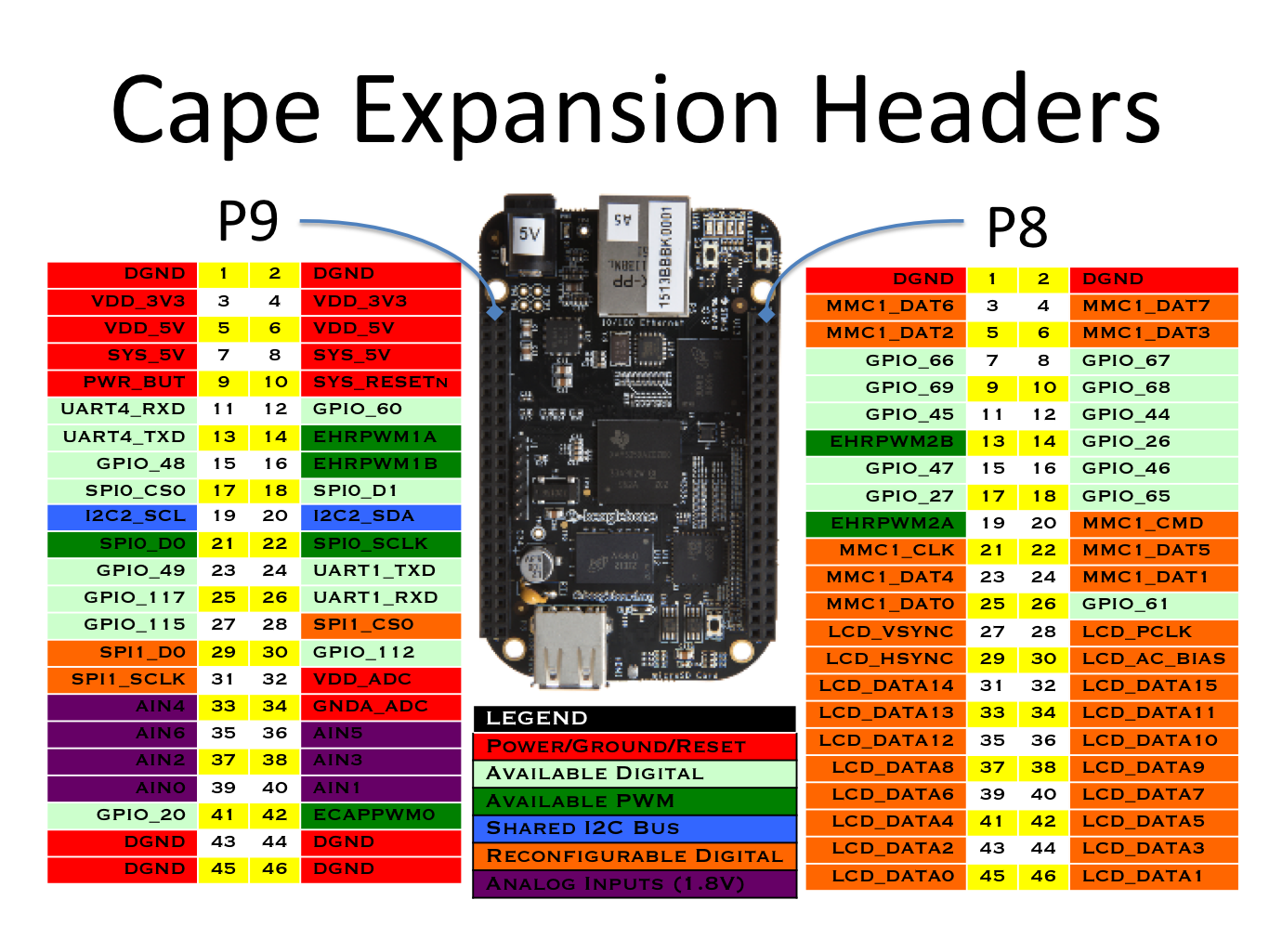
BeagleBone users will often refer to the "Cape Exanpsion Headers" pin
diagram [1] as it is in the "Bone101" getting started tutorial. [2]

Most of the P8 and P9 header pins can muxed to a GPIO line.  The
gpio-line-names describe which P8 or P9 pin that line goes to and the
default mux for that P8 or P9 pin if it is not GPIO.

For example, gpiochip 1 line 0 is connected to P8 header pin 25 (P8_25)
however the default device tree has the corresponding BGA ball (ZCZ U7)
muxed to mmc1_dat0 as it is used for the on-board eMMC chip.  For that
GPIO line to be used, one would need to modify the device tree to
disable the eMMC and change the pin mux for that ball to GPIO mode.

Some of the AM3358 ZCZ balls corresponding to GPIO lines are not routed
to a P8 or P9 header, but are instead wired to some peripheral device
like on-board eMMC, HDMI framer IC, or status LEDs.  Those names are in
brackets to denote those GPIO lines can not be used.

Some GPIO lines are named "[NC]" as the corresponding balls are not
routed to anything on the PCB.

The goal for these names is to make it easier for a user viewing the
output of gpioinfo to determine which P8 or P9 pin is connected to a
GPIO line.  The output of gpioinfo on a BeagleBone Black would be:

gpiochip0 - 32 lines:
	line   0: "[ethernet]"       unused   input  active-high
	line   1: "[ethernet]"       unused   input  active-high
	line   2: "P9_22 [spi0_sclk]" unused input active-high
	line   3: "P9_21 [spi0_d0]" unused input active-high
	line   4: "P9_18 [spi0_d1]" unused input active-high
	line   5: "P9_17 [spi0_cs0]" unused input active-high
	line   6:  "[sd card]"         "cd"   input   active-low [used]
	line   7: "P9_42A [ecappwm0]" unused input active-high
	line   8: "P8_35 [hdmi]" unused input active-high
	line   9: "P8_33 [hdmi]" unused input active-high
	line  10: "P8_31 [hdmi]" unused input active-high
	line  11: "P8_32 [hdmi]" unused input active-high
	line  12: "P9_20 [i2c2_sda]" unused input active-high
	line  13: "P9_19 [i2c2_scl]" unused input active-high
	line  14: "P9_26 [uart1_rxd]" unused input active-high
	line  15: "P9_24 [uart1_txd]" unused input active-high
	line  16: "[ethernet]"       unused   input  active-high
	line  17: "[ethernet]"       unused   input  active-high
	line  18:      "[usb]"       unused   input  active-high
	line  19:     "[hdmi]"       unused   input  active-high
	line  20:     "P9_41B"       unused   input  active-high
	line  21: "[ethernet]"       unused   input  active-high
	line  22: "P8_19 [ehrpwm2a]" unused input active-high
	line  23: "P8_13 [ehrpwm2b]" unused input active-high
	line  24:       "[NC]"       unused   input  active-high
	line  25:       "[NC]"       unused   input  active-high
	line  26:      "P8_14"       unused   input  active-high
	line  27:      "P8_17"       unused   input  active-high
	line  28: "[ethernet]"       unused   input  active-high
	line  29: "[ethernet]"       unused   input  active-high
	line  30: "P9_11 [uart4_rxd]" unused input active-high
	line  31: "P9_13 [uart4_txd]" unused input active-high
gpiochip1 - 32 lines:
	line   0: "P8_25 [emmc]" unused input active-high
	line   1:     "[emmc]"       unused   input  active-high
	line   2: "P8_5 [emmc]" unused input active-high
	line   3: "P8_6 [emmc]" unused input active-high
	line   4: "P8_23 [emmc]" unused input active-high
	line   5: "P8_22 [emmc]" unused input active-high
	line   6: "P8_3 [emmc]" unused input active-high
	line   7: "P8_4 [emmc]" unused input active-high
	line   8:       "[NC]"       unused   input  active-high
	line   9:       "[NC]"       unused   input  active-high
	line  10:       "[NC]"       unused   input  active-high
	line  11:       "[NC]"       unused   input  active-high
	line  12:      "P8_12"       unused   input  active-high
	line  13:      "P8_11"       unused   input  active-high
	line  14:      "P8_16"       unused   input  active-high
	line  15:      "P8_15"       unused   input  active-high
	line  16:     "P9_15A"       unused   input  active-high
	line  17:      "P9_23"       unused   input  active-high
	line  18: "P9_14 [ehrpwm1a]" unused input active-high
	line  19: "P9_16 [ehrpwm1b]" unused input active-high
	line  20:     "[emmc]"       unused   input  active-high
	line  21: "[usr0 led]" "beaglebone:green:heartbeat" output active-high [used]
	line  22: "[usr1 led]" "beaglebone:green:mmc0" output active-high [used]
	line  23: "[usr2 led]" "beaglebone:green:usr2" output active-high [used]
	line  24: "[usr3 led]" "beaglebone:green:usr3" output active-high [used]
	line  25:     "[hdmi]"  "interrupt"   input  active-high [used]
	line  26:      "[usb]"       unused   input  active-high
	line  27: "[hdmi audio]" "enable" output active-high [used]
	line  28:      "P9_12"       unused   input  active-high
	line  29:      "P8_26"       unused   input  active-high
	line  30: "P8_21 [emmc]" unused input active-high
	line  31: "P8_20 [emmc]" unused input active-high
gpiochip2 - 32 lines:
	line   0:     "P9_15B"       unused   input  active-high
	line   1:      "P8_18"       unused   input  active-high
	line   2:       "P8_7"       unused   input  active-high
	line   3:       "P8_8"       unused   input  active-high
	line   4:      "P8_10"       unused   input  active-high
	line   5:       "P8_9"       unused   input  active-high
	line   6: "P8_45 [hdmi]" unused input active-high
	line   7: "P8_46 [hdmi]" unused input active-high
	line   8: "P8_43 [hdmi]" unused input active-high
	line   9: "P8_44 [hdmi]" unused input active-high
	line  10: "P8_41 [hdmi]" unused input active-high
	line  11: "P8_42 [hdmi]" unused input active-high
	line  12: "P8_39 [hdmi]" unused input active-high
	line  13: "P8_40 [hdmi]" unused input active-high
	line  14: "P8_37 [hdmi]" unused input active-high
	line  15: "P8_38 [hdmi]" unused input active-high
	line  16: "P8_36 [hdmi]" unused input active-high
	line  17: "P8_34 [hdmi]" unused input active-high
	line  18: "[ethernet]"       unused   input  active-high
	line  19: "[ethernet]"       unused   input  active-high
	line  20: "[ethernet]"       unused   input  active-high
	line  21: "[ethernet]"       unused   input  active-high
	line  22: "P8_27 [hdmi]" unused input active-high
	line  23: "P8_29 [hdmi]" unused input active-high
	line  24: "P8_28 [hdmi]" unused input active-high
	line  25: "P8_30 [hdmi]" unused input active-high
	line  26:     "[emmc]"       unused   input  active-high
	line  27:     "[emmc]"       unused   input  active-high
	line  28:     "[emmc]"       unused   input  active-high
	line  29:     "[emmc]"       unused   input  active-high
	line  30:     "[emmc]"       unused   input  active-high
	line  31:     "[emmc]"       unused   input  active-high
gpiochip3 - 32 lines:
	line   0: "[ethernet]"       unused   input  active-high
	line   1: "[ethernet]"       unused   input  active-high
	line   2: "[ethernet]"       unused   input  active-high
	line   3: "[ethernet]"       unused   input  active-high
	line   4: "[ethernet]"       unused   input  active-high
	line   5:     "[i2c0]"       unused   input  active-high
	line   6:     "[i2c0]"       unused   input  active-high
	line   7:      "[emu]"       unused   input  active-high
	line   8:      "[emu]"       unused   input  active-high
	line   9: "[ethernet]"       unused   input  active-high
	line  10: "[ethernet]"       unused   input  active-high
	line  11:       "[NC]"       unused   input  active-high
	line  12:       "[NC]"       unused   input  active-high
	line  13:      "[usb]"       unused   input  active-high
	line  14: "P9_31 [spi1_sclk]" unused input active-high
	line  15: "P9_29 [spi1_d0]" unused input active-high
	line  16: "P9_30 [spi1_d1]" unused input active-high
	line  17: "P9_28 [spi1_cs0]" unused input active-high
	line  18: "P9_42B [ecappwm0]" unused input active-high
	line  19:      "P9_27"       unused   input  active-high
	line  20:     "P9_41A"       unused   input  active-high
	line  21:      "P9_25"       unused   input  active-high
	line  22:       "[NC]"       unused   input  active-high
	line  23:       "[NC]"       unused   input  active-high
	line  24:       "[NC]"       unused   input  active-high
	line  25:       "[NC]"       unused   input  active-high
	line  26:       "[NC]"       unused   input  active-high
	line  27:       "[NC]"       unused   input  active-high
	line  28:       "[NC]"       unused   input  active-high
	line  29:       "[NC]"       unused   input  active-high
	line  30:       "[NC]"       unused   input  active-high
	line  31:       "[NC]"       unused   input  active-high

[0] https://git.io/JfgOd
[1] https://beagleboard.org/capes
[1] https://beagleboard.org/Support/bone101
[2] https://beagleboard.org/static/images/cape-headers.png

Reviewed-by: Jason Kridner <jason@beagleboard.org>
Reviewed-by: Robert Nelson <robertcnelson@gmail.com>
Signed-off-by: Drew Fustini <drew@beagleboard.org>
Signed-off-by: Tony Lindgren <tony@atomide.com>
Add gpio-ranges properties to the gpio controller nodes.

These gpio-ranges were created based on "Table 9-10. CONTROL_MODULE
REGISTERS" in the  "AM335x Technical Reference Manual" [0] and "Table
4-2. Pin Attributes" in the "AM335x Sitara Processor datasheet" [1].
A csv file with this data is available for reference [2].

These mappings are valid for all SoC's that are using am33xx-l4.dtsi.
In addition, the only TI AM33xx parts that actually exist are [0]:
AM3351, AM3352, AM3354, AM3356, AM3357, AM3358, AM3359

These gpio-ranges properties should be added as they describe the
relationship between a gpio line and pin control register that exists
in the hardware.  For example, GPMC_A0 pin has mode 7 which is labeled
gpio1_16. conf_gpmc_a0 register is at offset 840h which makes it pin 16.

[0] https://www.ti.com/lit/ug/spruh73q/spruh73q.pdf
[1] http://www.ti.com/lit/ds/symlink/am3358.pdf
[2] https://gist.github.com/pdp7/6ffaddc8867973c1c3e8612cfaf72020
[3] http://www.ti.com/processors/sitara-arm/am335x-cortex-a8/overview.html

Signed-off-by: Drew Fustini <drew@beagleboard.org>
Signed-off-by: Tony Lindgren <tony@atomide.com>