This change makes it so that the VF can support the PF/VF API negotiation
protocol.  Specifically in this case we are adding support for API 1.0
which will mean that the VF is capable of cleaning up buffers that span
multiple descriptors without triggering an error.

Signed-off-by: Alexander Duyck <alexander.h.duyck@intel.com>
Tested-by: Sibai Li <sibai.li@intel.com>
Signed-off-by: Jeff Kirsher <jeffrey.t.kirsher@intel.com>
Current implementation enables EEE on only i350 device. This patch enables
EEE on all eee_supported devices. Also, configured LPI clock to keep
running before EEE is enabled on i210 and i211 devices.

Signed-off-by: Akeem G. Abodunrin <akeem.g.abodunrin@intel.com>
Tested-by: Jeff Pieper  <jeffrey.e.pieper@intel.com>
Signed-off-by: Jeff Kirsher <jeffrey.t.kirsher@intel.com>
For some reason the reading of the RQDPC register was being artificially
limited to 4K.  Instead of limiting the value we should read the value and
add the full amount.  Otherwise this can lead to a misleading number of
dropped packets when the actual value is in fact much higher.

Signed-off-by: Alexander Duyck <alexander.h.duyck@intel.com>
Tested-by: Jeff Pieper   <jeffrey.e.pieper@intel.com>
Signed-off-by: Jeff Kirsher <jeffrey.t.kirsher@intel.com>
While going through Ubuntu bugs, I discovered this patch being
posted and a confirmation that the patch works as expected.

Finding out how the hw volume really works would be preferrable
to just disabling the broken one, but this would be better than
nothing.

Credit: sndfnsdfin (qawsnews)
BugLink: https://bugs.launchpad.net/bugs/559939
Signed-off-by: David Henningsson <david.henningsson@canonical.com>
Signed-off-by: Takashi Iwai <tiwai@suse.de>
In the IBSS auth TX debug message the BSSID and DA
address are reversed, fix that.

Signed-off-by: Sylvain Roger Rieunier <sylvain.roger.rieunier@gmail.com>
[reword commit message and make it fit 72 cols]
Signed-off-by: Johannes Berg <johannes.berg@intel.com>
Here we add the required documentation for the new Device Tree
bindings pertaining to the MSP CPU-side DAI Driver.

Acked-by: Ola Lilja <ola.o.lilja@stericsson.com>
Signed-off-by: Lee Jones <lee.jones@linaro.org>
Here we add the required documentation for the new Device Tree
bindings pertaining to the MOP500 Audio Machine driver.

Acked-by: Ola Lilja <ola.o.lilja@stericsson.com>
Signed-off-by: Lee Jones <lee.jones@linaro.org>
Includes removal of duplicate debug print affirming entry into
the probe function, an unnecessary line break of a coding line
<80 chars and a white space change (unintentional tab).

Acked-by: Ola Lilja <ola.o.lilja@stericsson.com>
Signed-off-by: Lee Jones <lee.jones@linaro.org>
We continue to allow the AB8500 CODEC to be registered via the AB8500
Multi Functional Device API, only this time we extract its configuration
from the Device Tree binary.

Acked-by: Ola Lilja <ola.o.lilja@stericsson.com>
Acked-by: Linus Walleij <linus.walleij@linaro.org>
Signed-off-by: Lee Jones <lee.jones@linaro.org>
Register both parts of the MSP driver from Device Tree so that they
are probed when Device Tree is enabled. Also, as there is platform
data involved, we ensure that there is allocated memory to place the
configuration into and that the correct information is extracted from
the DT binary.

Acked-by: Ola Lilja <ola.o.lilja@stericsson.com>
Acked-by: Linus Walleij <linus.walleij@linaro.org>
Signed-off-by: Lee Jones <lee.jones@linaro.org>
Here we ensure that the MOP500 audio driver will be probed during a
Device Tree boot. We also parse the sound node to link together the
codec, dma and the CPU-side Digital Audio Interface.

Acked-by: Ola Lilja <ola.o.lilja@stericsson.com>
Acked-by: Linus Walleij <linus.walleij@linaro.org>
Signed-off-by: Lee Jones <lee.jones@linaro.org>
In the initial submission of the MSP driver msp1 and msp3's associated
pinctrl mechanism was passed back to platform code using a plat_init()
call-back routine, but it has no place in platform code. The MSP driver
should set this up for the appropriate ports. Instead we use a use_pinctrl
identifier which is passed from platform_data/Device Tree which indicates
which ports should use pinctrl.

Acked-by: Ola Lilja <ola.o.lilja@stericsson.com>
Acked-by: Linus Walleij <linus.walleij@linaro.org>
Signed-off-by: Lee Jones <lee.jones@linaro.org>
Instead of having to duplicate the description of the properties needed
for interrupt support, reference the new standard document.

Cc: Grant Likely <grant.likely@secretlab.ca>
Cc: Rob Herring <rob.herring@calxeda.com>
Cc: devicetree-discuss@lists.ozlabs.org
Cc: linux-kernel@vger.kernel.org
Signed-off-by: Thierry Reding <thierry.reding@avionic-design.de>
[Minor spelling correction]
Signed-off-by: Linus Walleij <linus.walleij@linaro.org>
In ext4_nonda_switch(), if the file system is getting full we used to
call writeback_inodes_sb_if_idle().  The problem is that we can be
holding i_mutex already, and this causes a potential deadlock when
writeback_inodes_sb_if_idle() when it tries to take s_umount.  (See
lockdep output below).

As it turns out we don't need need to hold s_umount; the fact that we
are in the middle of the write(2) system call will keep the superblock
pinned.  Unfortunately writeback_inodes_sb() checks to make sure
s_umount is taken, and the VFS uses a different mechanism for making
sure the file system doesn't get unmounted out from under us.  The
simplest way of dealing with this is to just simply grab s_umount
using a trylock, and skip kicking the writeback flusher thread in the
very unlikely case that we can't take a read lock on s_umount without
blocking.

Also, we now check the cirteria for kicking the writeback thread
before we decide to whether to fall back to non-delayed writeback, so
if there are any outstanding delayed allocation writes, we try to get
them resolved as soon as possible.

   [ INFO: possible circular locking dependency detected ]
   3.6.0-rc1-00042-gce894ca #367 Not tainted
   -------------------------------------------------------
   dd/8298 is trying to acquire lock:
    (&type->s_umount_key#18){++++..}, at: [<c02277d4>] writeback_inodes_sb_if_idle+0x28/0x46

   but task is already holding lock:
    (&sb->s_type->i_mutex_key#8){+.+...}, at: [<c01ddcce>] generic_file_aio_write+0x5f/0xd3

   which lock already depends on the new lock.

   2 locks held by dd/8298:
    #0:  (sb_writers#2){.+.+.+}, at: [<c01ddcc5>] generic_file_aio_write+0x56/0xd3
    #1:  (&sb->s_type->i_mutex_key#8){+.+...}, at: [<c01ddcce>] generic_file_aio_write+0x5f/0xd3

   stack backtrace:
   Pid: 8298, comm: dd Not tainted 3.6.0-rc1-00042-gce894ca #367
   Call Trace:
    [<c015b79c>] ? console_unlock+0x345/0x372
    [<c06d62a1>] print_circular_bug+0x190/0x19d
    [<c019906c>] __lock_acquire+0x86d/0xb6c
    [<c01999db>] ? mark_held_locks+0x5c/0x7b
    [<c0199724>] lock_acquire+0x66/0xb9
    [<c02277d4>] ? writeback_inodes_sb_if_idle+0x28/0x46
    [<c06db935>] down_read+0x28/0x58
    [<c02277d4>] ? writeback_inodes_sb_if_idle+0x28/0x46
    [<c02277d4>] writeback_inodes_sb_if_idle+0x28/0x46
    [<c026f3b2>] ext4_nonda_switch+0xe1/0xf4
    [<c0271ece>] ext4_da_write_begin+0x27/0x193
    [<c01dcdb0>] generic_file_buffered_write+0xc8/0x1bb
    [<c01ddc47>] __generic_file_aio_write+0x1dd/0x205
    [<c01ddce7>] generic_file_aio_write+0x78/0xd3
    [<c026d336>] ext4_file_write+0x480/0x4a6
    [<c0198c1d>] ? __lock_acquire+0x41e/0xb6c
    [<c0180944>] ? sched_clock_cpu+0x11a/0x13e
    [<c01967e9>] ? trace_hardirqs_off+0xb/0xd
    [<c018099f>] ? local_clock+0x37/0x4e
    [<c0209f2c>] do_sync_write+0x67/0x9d
    [<c0209ec5>] ? wait_on_retry_sync_kiocb+0x44/0x44
    [<c020a7b9>] vfs_write+0x7b/0xe6
    [<c020a9a6>] sys_write+0x3b/0x64
    [<c06dd4bd>] syscall_call+0x7/0xb

Signed-off-by: "Theodore Ts'o" <tytso@mit.edu>
Cc: stable@vger.kernel.org
Add myself as the maintainer for the BCM2835 ARM support, and related
drivers. This is mainly so that the MAINTAINERS file contains some
relevant entry, and the rpi/ARM mailing lists; I'd be quite happy if
anyone else came along and wanted to maintain/co-maintain this.

Signed-off-by: Stephen Warren <swarren@wwwdotorg.org>
This patch was extracted from git://github.com/lp0/linux.git branch
rpi-split as of 2012/09/08, and modified as follows:

* s/bcm2708/bcm2835/.
* Modified device tree vendor prefix.
* Modified UART DT node to use a unit-address to create unique UART node
  names, rather than using non-type names "uart0" and "uart1".
  Note that UART 1 (the Broadcom "mini UART") is not yet present, but
  I'm naming the DT node in anticipation that it will be added.

Signed-off-by: Chris Boot <bootc@bootc.net>
Signed-off-by: Simon Arlott <simon@fire.lp0.eu>
Signed-off-by: Dom Cobley <popcornmix@gmail.com>
Signed-off-by: Dom Cobley <dc4@broadcom.com>
Signed-off-by: Stephen Warren <swarren@wwwdotorg.org>
Acked-by: Arnd Bergmann <arnd@arndb.de>
This patch adds a minimal stub clock driver for the BCM2835. Its sole
purpose is to allow the PL011 AMBA clk_get() API calls to provide
something that looks enough like a clock that the driver probes and
operates correctly.

This patch was extracted from git://github.com/lp0/linux.git branch
rpi-split as of 2012/09/08, and modified as follows:

* Reworked to call clk_register_fixed_rate(), and clk_register_clkdev()
  rather than using static data to represent the clocks.
* Moved implementation to drivers/clk/.
* Modified .dev_id for UART clocks to match UART DT node names.
* s/bcm2708/bcm2835/.
* Modified device tree vendor prefix.

Signed-off-by: Chris Boot <bootc@bootc.net>
Signed-off-by: Simon Arlott <simon@fire.lp0.eu>
Signed-off-by: Dom Cobley <popcornmix@gmail.com>
Signed-off-by: Dom Cobley <dc4@broadcom.com>
Signed-off-by: Stephen Warren <swarren@wwwdotorg.org>
Acked-by: Mike Turquette <mturquette@linaro.org>
The System Timer peripheral provides four 32-bit timer channels and a
single 64-bit free running counter. Each channel has an output compare
register, which is compared against the 32 least significant bits of the
free running counter values, and generates an interrupt.

Timer 3 is used as the Linux timer.

The BCM2835 also contains an SP804-based timer module. However, it
apparently has significant differences from the standard SP804 IP block,
and Broadcom's documentation recommends using the system timer instead.

This patch was extracted from git://github.com/lp0/linux.git branch
rpi-split as of 2012/09/08, and modified as follows:

* s/bcm2708/bcm2835/.
* Modified device tree vendor prefix.
* Moved to drivers/clocksource/. This looks like the desired location for
  such code now.
* Added DT binding docs.
* Moved struct sys_timer bcm2835_timer into time.c to encapsulate it more.
* Simplified bcm2835_time_init() to find one matching node and operate on
  it, rather than looping over all matching nodes. This seems more
  consistent with other clocksource code.
* Simplified bcm2835_time_init() using of_iomap().
* Renamed struct bcm2835_timer.index to match_mask to better represent its
  purpose.
* s/printk(PR_INFO/pr_info(/

Signed-off-by: Chris Boot <bootc@bootc.net>
Signed-off-by: Simon Arlott <simon@fire.lp0.eu>
Signed-off-by: Dom Cobley <popcornmix@gmail.com>
Signed-off-by: Dom Cobley <dc4@broadcom.com>
Signed-off-by: Stephen Warren <swarren@wwwdotorg.org>
Acked-by: Arnd Bergmann <arnd@arndb.de>
The BCM2835 contains a custom interrupt controller, which supports 72
interrupt sources using a 2-level register scheme. The interrupt
controller, or the HW block containing it, is referred to occasionally
as "armctrl" in the SoC documentation, hence the symbol naming in the
code.

This patch was extracted from git://github.com/lp0/linux.git branch
rpi-split as of 2012/09/08, and modified as follows:

* s/bcm2708/bcm2835/.
* Modified device tree vendor prefix.
* Moved implementation to drivers/irchip/.
* Added devicetree documentation, and hence removed list of IRQs from
  bcm2835.dtsi.
* Changed shift in MAKE_HWIRQ() and HWIRQ_BANK() from 8 to 5 to reduce
  the size of the hwirq space, and pass the total size of the hwirq space
  to irq_domain_add_linear(), rather than just the number of valid hwirqs;
  the two are different due to the hwirq space being sparse.
* Added the interrupt controller DT node to the top-level of the DT,
  rather than nesting it inside a /axi node. Hence, changed the reg value
  since /axi had a ranges property. This seems simpler to me, but I'm not
  sure if everyone will like this change or not.
* Don't set struct irq_domain_ops.map = irq_domain_simple_map, hence
  removing the need to patch include/linux/irqdomain.h or
  kernel/irq/irqdomain.c.
* Simplified armctrl_of_init() using of_iomap().
* Removed unused IS_VALID_BANK()/IS_VALID_IRQ() macros.
* Renamed armctrl_handle_irq() to prevent possible symbol clashes.
* Made armctrl_of_init() static.
* Removed comment "Each bank is registered as a separate interrupt
  controller" since this is no longer true.
* Removed FSF address from license header.
* Added my name to copyright header.

Signed-off-by: Chris Boot <bootc@bootc.net>
Signed-off-by: Simon Arlott <simon@fire.lp0.eu>
Signed-off-by: Dom Cobley <popcornmix@gmail.com>
Signed-off-by: Dom Cobley <dc4@broadcom.com>
Signed-off-by: Stephen Warren <swarren@wwwdotorg.org>
Acked-by: Arnd Bergmann <arnd@arndb.de>
The BCM2835 is an ARM SoC from Broadcom. This patch adds very basic
support for this SoC.
http://www.broadcom.com/products/BCM2835http://www.raspberrypi.org/wp-content/uploads/2012/02/BCM2835-ARM-Peripherals.pdf
Note that the documentation in the latter .pdf assumes the MMU setup
that's used on the "VideoCore" companion processor, and does not document
physical peripheral addresses. Subtract 0x5e000000 to obtain the physical
addresses. This is accounted for by the ranges property in the /soc node
in the device tree.
The BCM2835 SoC is used in the Raspberry Pi. This patch also adds a
minimal device tree for this board; enough to see some very early kernel
boot messages through earlyprintk. However, this patch does not yet
provide a useful booting system.
http://www.raspberrypi.org/.
This patch was extracted from git://github.com/lp0/linux.git branch
rpi-split from 3-4 months ago, and significantly stripped down and
modified since.
Signed-off-by: Chris Boot <bootc@bootc.net>
Signed-off-by: Simon Arlott <simon@fire.lp0.eu>
Signed-off-by: Dom Cobley <popcornmix@gmail.com>
Signed-off-by: Dom Cobley <dc4@broadcom.com>
Signed-off-by: Stephen Warren <swarren@wwwdotorg.org>
Acked-by: Arnd Bergmann <arnd@arndb.de>
The r8169 driver currently limits the DMA burst for TX to 1024 bytes. I have
a box where this prevents the interface from using the gigabit line to its full
potential. This patch solves the problem by setting TX_DMA_BURST to unlimited.

The box has an ASRock B75M motherboard with on-board RTL8168evl/8111evl
(XID 0c900880). TSO is enabled.

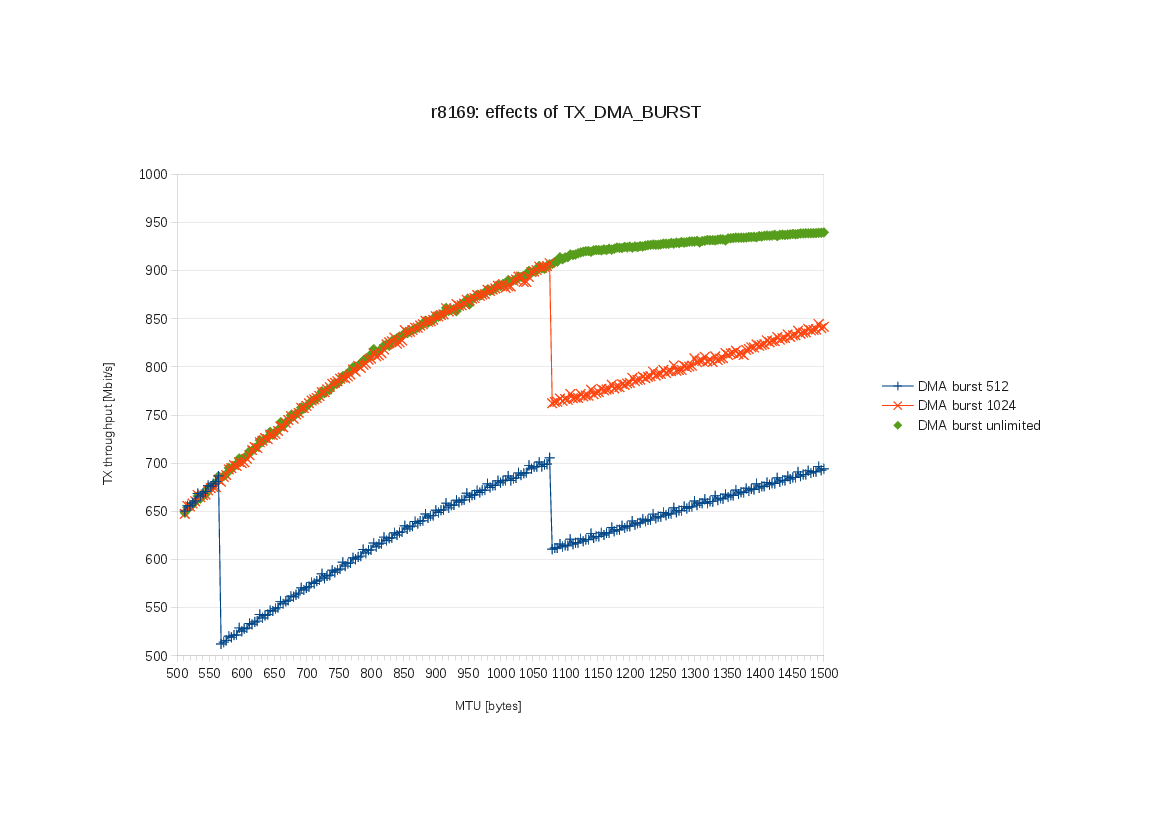
I used netperf (TCP_STREAM test) to measure the dependency of TX throughput
on MTU. I did it for three different values of TX_DMA_BURST ('5'=512, '6'=1024,
'7'=unlimited). This chart shows the results:
http://michich.fedorapeople.org/r8169/r8169-effects-of-TX_DMA_BURST.png

Interesting points:
 - With the current DMA burst limit (1024):
   - at the default MTU=1500 I get only 842 Mbit/s.
   - when going from small MTU, the performance rises monotonically with
     increasing MTU only up to a peak at MTU=1076 (908 MBit/s). Then there's
     a sudden drop to 762 MBit/s from which the throughput rises monotonically
     again with further MTU increases.
 - With a smaller DMA burst limit (512):
   - there's a similar peak at MTU=1076 and another one at MTU=564.
 - With unlimited DMA burst:
   - at the default MTU=1500 I get nice 940 Mbit/s.
   - the throughput rises monotonically with increasing MTU with no strange
     peaks.

Notice that the peaks occur at MTU sizes that are multiples of the DMA burst
limit plus 52. Why 52? Because:
  20 (IP header) + 20 (TCP header) + 12 (TCP options) = 52

The Realtek-provided r8168 driver (v8.032.00) uses unlimited TX DMA burst too,
except for CFG_METHOD_1 where the TX DMA burst is set to 512 bytes.
CFG_METHOD_1 appears to be the oldest MAC version of "RTL8168B/8111B",
i.e. RTL_GIGA_MAC_VER_11 in r8169. Not sure if this MAC version really needs
the smaller burst limit, or if any other versions have similar requirements.

Signed-off-by: Michal Schmidt <mschmidt@redhat.com>
Acked-by: Francois Romieu <romieu@fr.zoreil.com>
Signed-off-by: David S. Miller <davem@davemloft.net>
copy_to_user() returns the number of bytes remaining, but we want a
negative error code here.

Signed-off-by: Axel Lin <axel.lin@gmail.com>
Signed-off-by: Dmitry Torokhov <dtor@mail.ru>
Instead of doing a shutdown() call, we need to do an actual close().
Ditto if/when the server is sending us junk RPC headers.

Signed-off-by: Trond Myklebust <Trond.Myklebust@netapp.com>
Tested-by: Simon Kirby <sim@hostway.ca>
Cc: stable@vger.kernel.org
When lifing finger off the surface some versions of touchpad send movement
packets with very low coordinates, which cause cursor to jump to the upper
left corner of the screen. Let's ignore least significant bits of X and Y
coordinates if higher bits are all zeroes and consider finger not touching
the pad.

Bugzilla: https://bugzilla.kernel.org/show_bug.cgi?id=43197
Reported-and-tested-by:	Aleksey Spiridonov <leks13@leks13.ru>
Tested-by: Eddie Dunn <eddie.dunn@gmail.com>
Tested-by: Jakub Luzny <limoto94@gmail.com>
Tested-by: Olivier Goffart <olivier@woboq.com>
Signed-off-by: Tai-hwa Liang <avatar@sentelic.com>
Signed-off-by: Dmitry Torokhov <dtor@mail.ru>
Clocks must be prepared before enabling and unprepared
after disabling. Use appropriate functions to do this
in one go.

Signed-off-by: Pawel Moll <pawel.moll@arm.com>
Signed-off-by: Dmitry Torokhov <dtor@mail.ru>
On Toshiba Satellite C850D, the touchpad and the keyboard might randomly
not work at boot. Preventing MUX mode activation solves this issue.

Signed-off-by: Anisse Astier <anisse@astier.eu>
Cc: stable@kernel.org
Signed-off-by: Dmitry Torokhov <dtor@mail.ru>
Pull Input and HID updates for 3.7 from Henrik Rydberg:
"The tree contains input core changes, Acked by Dmitry, which substantially
reduces the irqsoff latency for all input devices. It also contains MT changes
which allows further memory reduction, speedup and hardware support in the HID
Multitouch driver. Lastly, you get the conversion of the bcm5974 driver to
MT-B, which due to the mixed dependency of the tree fits better here than
anywhere else."

Signed-off-by: Jiri Kosina <jkosina@suse.cz>
It should be the skb which is not cloned

Signed-off-by: Li RongQing <roy.qing.li@gmail.com>
Acked-by: Eric Dumazet <edumazet@google.com>
Signed-off-by: David S. Miller <davem@davemloft.net>
Cc: Herbert Xu <herbert@gondor.apana.org.au>
Cc: Michal Kubeček <mkubecek@suse.cz>
Cc: David Miller <davem@davemloft.net>
Signed-off-by: Cong Wang <amwang@redhat.com>
Signed-off-by: David S. Miller <davem@davemloft.net>
Cc: Herbert Xu <herbert@gondor.apana.org.au>
Cc: Michal Kubeček <mkubecek@suse.cz>
Cc: David Miller <davem@davemloft.net>
Signed-off-by: Cong Wang <amwang@redhat.com>
Signed-off-by: David S. Miller <davem@davemloft.net>
Two years ago, Shan Wei tried to fix this:
http://patchwork.ozlabs.org/patch/43905/

The problem is that RFC2460 requires an ICMP Time
Exceeded -- Fragment Reassembly Time Exceeded message should be
sent to the source of that fragment, if the defragmentation
times out.

"
   If insufficient fragments are received to complete reassembly of a
   packet within 60 seconds of the reception of the first-arriving
   fragment of that packet, reassembly of that packet must be
   abandoned and all the fragments that have been received for that
   packet must be discarded.  If the first fragment (i.e., the one
   with a Fragment Offset of zero) has been received, an ICMP Time
   Exceeded -- Fragment Reassembly Time Exceeded message should be
   sent to the source of that fragment.
"

As Herbert suggested, we could actually use the standard IPv6
reassembly code which follows RFC2460.

With this patch applied, I can see ICMP Time Exceeded sent
from the receiver when the sender sent out 3/4 fragmented
IPv6 UDP packet.

Cc: Herbert Xu <herbert@gondor.apana.org.au>
Cc: Michal Kubeček <mkubecek@suse.cz>
Cc: David Miller <davem@davemloft.net>
Cc: Hideaki YOSHIFUJI <yoshfuji@linux-ipv6.org>
Cc: Patrick McHardy <kaber@trash.net>
Cc: Pablo Neira Ayuso <pablo@netfilter.org>
Cc: netfilter-devel@vger.kernel.org
Signed-off-by: Cong Wang <amwang@redhat.com>
Signed-off-by: David S. Miller <davem@davemloft.net>
As pointed by Michal, it is necessary to add a new
namespace for nf_conntrack_reasm code, this prepares
for the second patch.

Cc: Herbert Xu <herbert@gondor.apana.org.au>
Cc: Michal Kubeček <mkubecek@suse.cz>
Cc: David Miller <davem@davemloft.net>
Cc: Patrick McHardy <kaber@trash.net>
Cc: Pablo Neira Ayuso <pablo@netfilter.org>
Cc: netfilter-devel@vger.kernel.org
Signed-off-by: Cong Wang <amwang@redhat.com>
Signed-off-by: David S. Miller <davem@davemloft.net>
In netpoll tx path, we miss the chance of calling ->ndo_select_queue(),
thus could cause problems when bonding is involved.

This patch makes dev_pick_tx() extern (and rename it to netdev_pick_tx())
to let netpoll call it in netpoll_send_skb_on_dev().

Reported-by: Sylvain Munaut <s.munaut@whatever-company.com>
Cc: "David S. Miller" <davem@davemloft.net>
Cc: Eric Dumazet <edumazet@google.com>
Signed-off-by: Cong Wang <amwang@redhat.com>
Tested-by: Sylvain Munaut <s.munaut@whatever-company.com>
Signed-off-by: David S. Miller <davem@davemloft.net>
Running cpufreq driver on imx6q, the following warning is seen.

$ BUG: sleeping function called from invalid context at kernel/mutex.c:269

<snip>

stack backtrace:
Backtrace:
[<80011d64>] (dump_backtrace+0x0/0x10c) from [<803fc164>] (dump_stack+0x18/0x1c)
 r6:bf8142e0 r5:bf814000 r4:806ac794 r3:bf814000
[<803fc14c>] (dump_stack+0x0/0x1c) from [<803fd444>] (print_usage_bug+0x250/0x2b
8)
[<803fd1f4>] (print_usage_bug+0x0/0x2b8) from [<80060f90>] (mark_lock+0x56c/0x67
0)
[<80060a24>] (mark_lock+0x0/0x670) from [<80061a20>] (__lock_acquire+0x98c/0x19b
4)
[<80061094>] (__lock_acquire+0x0/0x19b4) from [<80062f14>] (lock_acquire+0x68/0x
7c)
[<80062eac>] (lock_acquire+0x0/0x7c) from [<80400f28>] (mutex_lock_nested+0x78/0
x344)
 r7:00000000 r6:bf872000 r5:805cc858 r4:805c2a04
[<80400eb0>] (mutex_lock_nested+0x0/0x344) from [<803089ac>] (clk_get_rate+0x1c/
0x58)
[<80308990>] (clk_get_rate+0x0/0x58) from [<80013c48>] (twd_update_frequency+0x1
8/0x50)
 r5:bf253d04 r4:805cadf4
[<80013c30>] (twd_update_frequency+0x0/0x50) from [<80068e20>] (generic_smp_call
_function_single_interrupt+0xd4/0x13c)
 r4:bf873ee0 r3:80013c30
[<80068d4c>] (generic_smp_call_function_single_interrupt+0x0/0x13c) from [<80013
34c>] (handle_IPI+0xc0/0x194)
 r8:00000001 r7:00000000 r6:80574e48 r5:bf872000 r4:80593958
[<8001328c>] (handle_IPI+0x0/0x194) from [<800084e8>] (gic_handle_irq+0x58/0x60)
 r8:00000000 r7:bf873f8c r6:bf873f58 r5:80593070 r4:f4000100
r3:00000005
[<80008490>] (gic_handle_irq+0x0/0x60) from [<8000e124>] (__irq_svc+0x44/0x60)
Exception stack(0xbf873f58 to 0xbf873fa0)
3f40:                                                       00000001 00000001
3f60: 00000000 bf814000 bf872000 805cab48 80405aa4 80597648 00000000 412fc09a
3f80: bf872000 bf873fac bf873f70 bf873fa0 80063844 8000f1f8 20000013 ffffffff
 r6:ffffffff r5:20000013 r4:8000f1f8 r3:bf814000
[<8000f1b8>] (default_idle+0x0/0x4c) from [<8000f428>] (cpu_idle+0x98/0x114)
[<8000f390>] (cpu_idle+0x0/0x114) from [<803f9834>] (secondary_start_kernel+0x11
c/0x140)
[<803f9718>] (secondary_start_kernel+0x0/0x140) from [<103f9234>] (0x103f9234)
 r6:10c03c7d r5:0000001f r4:4f86806a r3:803f921c

It looks that the warning is caused by that twd_update_frequency() gets
called from an atomic context while it calls clk_get_rate() where a
mutex gets held.

To fix the warning, let's convert common clk users over to clk notifiers
in place of CPUfreq notifiers.  This works out nicely for Cortex-A9
MPcore designs that scale all CPUs at the same frequency.

Platforms that have not been converted to the common clk framework and
support CPUfreq will rely on the old mechanism.  Once these platforms
are converted over fully then we can remove the CPUfreq-specific bits
for good.

Signed-off-by: Mike Turquette <mturquette@linaro.org>
Signed-off-by: Shawn Guo <shawn.guo@linaro.org>
Reviewed-by: Linus Walleij <linus.walleij@linaro.org>
Reviewed-by: Ulf Hansson <ulf.hansson@linaro.org>
Signed-off-by: Russell King <rmk+kernel@arm.linux.org.uk>
Remove the offset from ipi_msg_type and assume that SGI0 is the
wakeup interrupt now that all WFI hotplug users call
gic_raise_softirq() with 0 instead of 1. This allows us to
track how many wakeup interrupts are sent and also removes the
unknown IPI printk message for WFI hotplug based systems.

Reviewed-by: Nicolas Pitre <nico@linaro.org>
Signed-off-by: Stephen Boyd <sboyd@codeaurora.org>
Signed-off-by: Russell King <rmk+kernel@arm.linux.org.uk>
Surprisingly devres_destroy() doesn't call the destructor for the
resource it is destroying, use the newly added devres_release() instead
to fix this.

Signed-off-by: Mark Brown <broonie@opensource.wolfsonmicro.com>
Signed-off-by: Russell King <rmk+kernel@arm.linux.org.uk>
When tracing system calls, a debugger may change the syscall number
in response to a SIGTRAP on syscall entry.

This patch ensures that the new syscall number is passed to the audit
code.

Signed-off-by: Will Deacon <will.deacon@arm.com>
Signed-off-by: Russell King <rmk+kernel@arm.linux.org.uk>
As specified by ftrace-design.txt, TIF_SYSCALL_TRACEPOINT was
added, as well as NR_syscalls in asm/unistd.h.  Additionally,
__sys_trace was modified to call trace_sys_enter and
trace_sys_exit when appropriate.

Tests #2 - #4 of "perf test" now complete successfully.

Signed-off-by: Steven Walter <stevenrwalter@gmail.com>
Signed-off-by: Wade Farnsworth <wade_farnsworth@mentor.com>
Signed-off-by: Will Deacon <will.deacon@arm.com>
Signed-off-by: Russell King <rmk+kernel@arm.linux.org.uk>
The internal functions for add/deleting addresses don't change
their argument.

Signed-off-by: Stephen Hemminger <shemminger@vyatta.com>
Signed-off-by: David S. Miller <davem@davemloft.net>
If the old timestamps of a class, say cl, are stale when the class
becomes active, then QFQ may assign to cl a much higher start time
than the maximum value allowed. This may happen when QFQ assigns to
the start time of cl the finish time of a group whose classes are
characterized by a higher value of the ratio
max_class_pkt/weight_of_the_class with respect to that of
cl. Inserting a class with a too high start time into the bucket list
corrupts the data structure and may eventually lead to crashes.
This patch limits the maximum start time assigned to a class.

Signed-off-by: Paolo Valente <paolo.valente@unimore.it>
Signed-off-by: David S. Miller <davem@davemloft.net>
If recv() syscall is called for a TCP socket so that
  - IOAT DMA is used
  - MSG_WAITALL flag is used
  - requested length is bigger than sk_rcvbuf
  - enough data has already arrived to bring rcv_wnd to zero
then when tcp_recvmsg() gets to calling sk_wait_data(), receive
window can be still zero while sk_async_wait_queue exhausts
enough space to keep it zero. As this queue isn't cleaned until
the tcp_service_net_dma() call, sk_wait_data() cannot receive
any data and blocks forever.

If zero receive window and non-empty sk_async_wait_queue is
detected before calling sk_wait_data(), process the queue first.

Signed-off-by: Michal Kubecek <mkubecek@suse.cz>
Signed-off-by: David S. Miller <davem@davemloft.net>
omap_device_get_by_hwmod_name() returns ERR_PTR on error.

Signed-off-by: Axel Lin <axel.lin@gmail.com>
Acked-by: Kevin Hilman <khilman@ti.com>
Signed-off-by: Rafael J. Wysocki <rjw@sisk.pl>
This mindless patch is just about removing some trailing
carriage returns.

[rjw: Changed the subject.]

Signed-off-by: Daniel Lezcano <daniel.lezcano@linaro.org>
Signed-off-by: Rafael J. Wysocki <rjw@sisk.pl>
This patch (as1591) moves the pm_runtime_get_noresume() and
pm_runtime_put_sync() calls from __device_suspend() and
device_resume() to device_prepare() and device_complete() in the PM
core.

The reason for doing this is to make sure that parent devices remain
at full power (i.e., don't go into runtime suspend) while their
children are being resumed from a system sleep.

The PCI core already contained equivalent code to serve the same
purpose.  The patch removes the duplicated code, since it is no longer
needed.  One of the comments from the PCI core gets moved into the PM
core, and a second comment is added to explain whe the _get_noresume
and _put_sync calls are present.

Signed-off-by: Alan Stern <stern@rowland.harvard.edu>
Signed-off-by: Rafael J. Wysocki <rjw@sisk.pl>
On some architectures test_bit() can return other values than 0 or 1:

With a generic x86 OpenWrt image in a kvm setup (batadv_)test_bit()
frequently returns -1 for me, leading to batadv_iv_ogm_update_seqnos()
wrongly signaling a protected seqno window.

This patch tries to fix this issue by making batadv_test_bit() return 0
or 1 only.

Signed-off-by: Linus Lüssing <linus.luessing@web.de>
Acked-by: Sven Eckelmann <sven@narfation.org>
Signed-off-by: Antonio Quartulli <ordex@autistici.org>
Signed-off-by: David S. Miller <davem@davemloft.net>
When building 64-bit kernel with this driver we get following warnings from
the compiler:

drivers/net/ethernet/i825xx/znet.c: In function ‘hardware_init’:
drivers/net/ethernet/i825xx/znet.c:863:29: warning: cast from pointer to integer of different size [-Wpointer-to-int-cast]
drivers/net/ethernet/i825xx/znet.c:870:29: warning: cast from pointer to integer of different size [-Wpointer-to-int-cast]

Fix these by calling isa_virt_to_bus() before passing the pointers to
set_dma_addr().

Signed-off-by: Mika Westerberg <mika.westerberg@linux.intel.com>
Signed-off-by: David S. Miller <davem@davemloft.net>
Add GSO support to GRE tunnels.

Signed-off-by: Eric Dumazet <edumazet@google.com>
Cc: Maciej Żenczykowski <maze@google.com>
Signed-off-by: David S. Miller <davem@davemloft.net>