To establish a connection between GPIO controllers and pin multiplexor
controller add gpio-ranges properties to all GPIO controllers found
on iMX50, iMX6Q/D, iMX6DL/S, iMX6SL, iMX6SX, iMX6UL and iMX7D/S
SoCs. The change was done after human parsing of output from

% gawk -n '{ sub(/.*__/, ""); if ($1 ~ "^GPIO") print $1, $2/4}' imxXX-pinfunc.h | sort -n

Signed-off-by: Vladimir Zapolskiy <vladimir_zapolskiy@mentor.com>
Signed-off-by: Shawn Guo <shawnguo@kernel.org>
hmi.c functions are unused unless sibling_subcore_state is nonzero, and
that in turn happens only if KVM is in use.  So move the code to
arch/powerpc/kvm/, putting it under CONFIG_KVM_BOOK3S_HV_POSSIBLE
rather than CONFIG_PPC_BOOK3S_64.  The sibling_subcore_state is also
included in struct paca_struct only if KVM is supported by the kernel.

Cc: Daniel Axtens <dja@axtens.net>
Cc: Michael Ellerman <mpe@ellerman.id.au>
Cc: Mahesh Salgaonkar <mahesh@linux.vnet.ibm.com>
Cc: Paul Mackerras <paulus@samba.org>
Cc: linuxppc-dev@lists.ozlabs.org
Cc: kvm-ppc@vger.kernel.org
Cc: kvm@vger.kernel.org
Signed-off-by: Paolo Bonzini <pbonzini@redhat.com>
Signed-off-by: Paul Mackerras <paulus@ozlabs.org>
This is a prerequisite to remove the static mappings for imx35 devicetree
based machines.

Signed-off-by: Uwe Kleine-König <u.kleine-koenig@pengutronix.de>
Reviewed-by: Fabio Estevam <fabio.estevam@nxp.com>
Signed-off-by: Shawn Guo <shawnguo@kernel.org>
This adds a new function pnv_opal_pci_msi_eoi() which does the part of
end-of-interrupt (EOI) handling of an MSI which involves doing an
OPAL call.  This function can be called in real mode.  This doesn't
just export pnv_ioda2_msi_eoi() because that does a call to
icp_native_eoi(), which does not work in real mode.

This also adds a function, is_pnv_opal_msi(), which KVM can call to
check whether an interrupt is one for which we should be calling
pnv_opal_pci_msi_eoi() when we need to do an EOI.

[paulus@ozlabs.org - split out the addition of pnv_opal_pci_msi_eoi()
 from Suresh's patch "KVM: PPC: Book3S HV: Handle passthrough
 interrupts in guest"; added is_pnv_opal_msi(); wrote description.]

Signed-off-by: Suresh Warrier <warrier@linux.vnet.ibm.com>
Signed-off-by: Paul Mackerras <paulus@ozlabs.org>
Add simple cache inhibited accessors for memory mapped I/O.
Unlike the accessors built from the DEF_MMIO_* macros, these
don't include any hardware memory barriers, callers need to
manage memory barriers on their own. These can only be called
in hypervisor real mode.

Signed-off-by: Suresh Warrier <warrier@linux.vnet.ibm.com>
[paulus@ozlabs.org - added line to comment]
Signed-off-by: Paul Mackerras <paulus@ozlabs.org>
This replaces a 2-D search through an array with a simple 8-bit table
lookup for determining the actual and/or base page size for a HPT entry.

The encoding in the second doubleword of the HPTE is designed to encode
the actual and base page sizes without using any more bits than would be
needed for a 4k page number, by using between 1 and 8 low-order bits of
the RPN (real page number) field to encode the page sizes.  A single
"large page" bit in the first doubleword indicates that these low-order
bits are to be interpreted like this.

We can determine the page sizes by using the low-order 8 bits of the RPN
to look up a 256-entry table.  For actual page sizes less than 1MB, some
of the upper bits of these 8 bits are going to be real address bits, but
we can cope with that by replicating the entries for those smaller page
sizes.

While we're at it, let's move the hpte_page_size() and hpte_base_page_size()
functions from a KVM-specific header to a header for 64-bit HPT systems,
since this computation doesn't have anything specifically to do with KVM.

Reviewed-by: Aneesh Kumar K.V <aneesh.kumar@linux.vnet.ibm.com>
Signed-off-by: Paul Mackerras <paulus@ozlabs.org>
The 'dma-coherent' indicates that the hardware IP block can ensure
the coherency of the data transferred from/to the IP block. This
can avoid the software cache flush/invalid actions, and improve
the performance significantly.

The PCI IP block of ls2080a has this capability, so adding this
feature to improve the PCI performance.

Signed-off-by: Liu Gang <Gang.Liu@nxp.com>
Signed-off-by: Shawn Guo <shawnguo@kernel.org>
User visible:

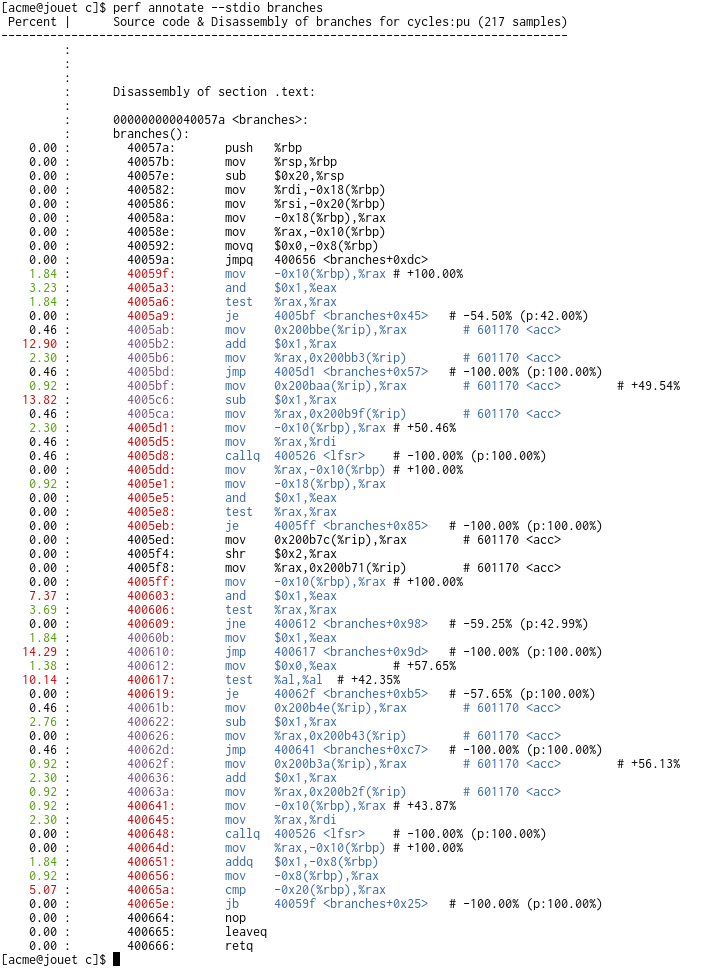
 - Add branch stack / basic block info to 'perf annotate --stdio', where for
   each branch, we add an asm comment after the instruction with information on
   how often it was taken and predicted. See example with color output at:

     http://vger.kernel.org/~acme/perf/annotate_basic_blocks.png

   (Peter Zijlstra)

 - Only open an evsel in CPUs in its cpu map, fixing some use cases in
   systems with multiple PMUs with different CPU maps (Mark Rutland)

 - Fix handling of huge TLB maps, recognizing it as anonymous (Wang Nan)

 Infrastructure:

 - Remove the symbol filtering code, i.e. the callbacks passed to all functions
   that could end up loading a DSO symtab, simplifying the code, eventually
   allowing what we should have had since day one: removing the 'map' parameter
   from dso__load() functions (Arnaldo Carvalho de Melo)

 Arch specific build fixes:

 - Fix detached tarball build on powerpc, where we were still accessing a
   file outside tools/ (Ravi Bangoria)

 Signed-off-by: Arnaldo Carvalho de Melo <acme@redhat.com>
 -----BEGIN PGP SIGNATURE-----
 Version: GnuPG v2

 iQIcBAABCAAGBQJX0cvBAAoJENZQFvNTUqpApYEP/jrnFfmcz3KBMl2szCkKG8zF
 Yl6kT31Og3BA595h4WlNpuKgFroPVj48H21ph/ZyxQWzQs9P9QrxcRKzERQKHOsl
 NFtZi3Up7+/0Llfg5cTxNnIqsw2Zwud5shjnOGk6hMy1Q+Bt7JX9wYV17X+FJ1LT
 YvDfIRo8wSJIGDJVnBAZrCFdQP3b2FztG9FQofwdO22FBBiEL6UYy+OemyXuN9XQ
 fvaMgKE2Ib+DHBVjj6kTFCZOX67oHN8GcjFXCjAL+Nt1OL6/eUsJrdmKEpYPMzEU
 HTov9AzqBoilF/9dd9on+73Yyyxo4QSMRkDW0b56kOFTP4JGdy0Fvvz9hFauGY+u
 1vexWWI2pzIrY8+L2qNCtMV346zv74Pmp/YrgDtCjT8Vk4bmKbLv+TdmusEyfXPu
 zouCqJnoAPxaTpwKV6QHjIZ9YV1nDhku5MAlJNKqQGPQvRFi2wChyyaHUjoXccK2
 aSrWsEWw/yCnFe4Gelar5lQ5EoPBufV+d55MfCqufO8OoPurAjUiLcw2HO+h08Vo
 4UdYph/RtmqlJJgSUBoLotyTkIf1YPWRpE+5E1NafgwmcqPLA0c+tlqctzg261KF
 qg3nqmS/C1TwHhUMvBIL78GyWx7jIEJ6rdTnGAxArJjB3PLZ9PUoZ51NOlKp+NcU
 dR5jWb8DBsmZRrjPxC9x
 =LkPB
 -----END PGP SIGNATURE-----

Merge tag 'perf-core-for-mingo-20160908' of git://git.kernel.org/pub/scm/linux/kernel/git/acme/linux into perf/core

Pull perf/core improvements and fixes from Arnaldo Carvalho de Melo:

User visible changes:

- Add branch stack / basic block info to 'perf annotate --stdio', where for
  each branch, we add an asm comment after the instruction with information on
  how often it was taken and predicted. See example with color output at:

    http://vger.kernel.org/~acme/perf/annotate_basic_blocks.png

  (Peter Zijlstra)

- Only open an evsel in CPUs in its cpu map, fixing some use cases in
  systems with multiple PMUs with different CPU maps (Mark Rutland)

- Fix handling of huge TLB maps, recognizing it as anonymous (Wang Nan)

Infrastructure changes:

- Remove the symbol filtering code, i.e. the callbacks passed to all functions
  that could end up loading a DSO symtab, simplifying the code, eventually
  allowing what we should have had since day one: removing the 'map' parameter
  from dso__load() functions (Arnaldo Carvalho de Melo)

Arch specific build fixes:

- Fix detached tarball build on powerpc, where we were still accessing a
  file outside tools/ (Ravi Bangoria)

Signed-off-by: Arnaldo Carvalho de Melo <acme@redhat.com>
Signed-off-by: Ingo Molnar <mingo@kernel.org>
This introduces a new rpmsg backend for the Qualcomm SMD system,
allowing communication with various remote processors found in Qualcomm
platforms. The implementation is based on, and intends to replace,
drivers/soc/qcom/smd.c with the necessary adaptions for fitting with the
rpmsg core.

Based on original work by Sricharan R <sricharan@codeaurora.org>

Cc: Sricharan R <sricharan@codeaurora.org>
Signed-off-by: Bjorn Andersson <bjorn.andersson@linaro.org>
Some rpmsg backends support holding on to and redelivering messages upon
failed handling of them, so provide a way for the callback to report and
error and allow the backends to handle this.

Signed-off-by: Bjorn Andersson <bjorn.andersson@linaro.org>
Move virtio rpmsg implementation details from the public header file to
the virtio rpmsg implementation.

Signed-off-by: Bjorn Andersson <bjorn.andersson@linaro.org>
Create a container struct virtio_rpmsg_channel around the rpmsg_channel
to keep virtio backend information separate from the rpmsg and public
API. This makes the public structures independant of virtio.

Signed-off-by: Bjorn Andersson <bjorn.andersson@linaro.org>
Move the device and endpoint indirection tables to the rpmsg internal
header file, to hide them from the public API.

Signed-off-by: Bjorn Andersson <bjorn.andersson@linaro.org>
Extract the generic rpmsg core functionality from the virtio rpmsg
implementation, splitting the implementation in a rpmsg core and a
virtio backend.

Based on initial work by Sricharan R <sricharan@codeaurora.org>

Cc: Sricharan R <sricharan@codeaurora.org>
Signed-off-by: Bjorn Andersson <bjorn.andersson@linaro.org>
The tail of create_channel() is common among all rpmsg backends, so
split it off from the virtio specific part to allow it to be extracted
to the rpmsg core.

Signed-off-by: Bjorn Andersson <bjorn.andersson@linaro.org>
Move the rpmsg_send() and rpmsg_destroy_ept() interface to the rpmsg
core, so that we eventually can hide the rpmsg_endpoint ops from the
public API.

Signed-off-by: Bjorn Andersson <bjorn.andersson@linaro.org>
Add indirection table for rpmsg_endpoint related operations and move
virtio implementation behind this, this finishes of the decoupling of
the virtio implementation from the public API.

Signed-off-by: Bjorn Andersson <bjorn.andersson@linaro.org>
Extract the now indirect rpmsg_create_ept() interface to a separate
file and start building up a rpmsg core.

Signed-off-by: Bjorn Andersson <bjorn.andersson@linaro.org>
To allow for multiple backend implementations add an indireection table
for rpmsg_device related operations and move the virtio implementation
behind this table.

Signed-off-by: Bjorn Andersson <bjorn.andersson@linaro.org>
The rpmsg device representing struct is called rpmsg_channel and the
variable name used throughout is rpdev, with the communication happening
on endpoints it's clearer to just call this a "device" in a public API.

Signed-off-by: Bjorn Andersson <bjorn.andersson@linaro.org>
As we introduce support for additional rpmsg backends, some of these
only supports point-to-point "links" represented by a name. By making
rpmsg_create_ept() take a channel_info struct we allow for these
backends to either be passed a source address, a destination address or
a name identifier.

Signed-off-by: Bjorn Andersson <bjorn.andersson@linaro.org>
The rpmsg_send() operations has been taking a rpmsg_device, but this
forces users of secondary rpmsg_endpoints to use the rpmsg_sendto()
interface - by extracting source and destination from the given data
structures. If we instead pass the rpmsg_endpoint to these functions a
service can use rpmsg_sendto() to respond to messages, even on secondary
endpoints.

In addition this would allow us to support operations on multiple
channels in future backends that does not support off-channel
operations.

Signed-off-by: Bjorn Andersson <bjorn.andersson@linaro.org>
By basing rpmsg device names on channel id we end up with human readable
device names in sysfs and debug logs.

Reviewed-by: Sarangdhar Joshi <spjoshi@codeaurora.org>
Signed-off-by: Bjorn Andersson <bjorn.andersson@linaro.org>
Make it possible to match rpmsg devices based on device tree node, in
addition to the id table. In some of these cases the rpmsg driver would
not have a id_table, so make this optional.

Signed-off-by: Bjorn Andersson <bjorn.andersson@linaro.org>
Simplify code and reduce code size by using the new hwmon
registration API.

Other changes:

- Convert to use regmap, and drop local caching. This avoids reading
  registers unnecessarily, and uses regmap for caching of non-volatile
  registers.
- Add support for temp2_max, temp2_max_alarm, temp2_max_hyst, and
  temp2_offset.
- Order include files alphabetically
- Drop FSF address
- Check errors from register read and write functions and report
  to userspace.
- Accept negative hysteresis values. While unlikely, a maximum limit
  _can_ be set to a value smaller than 31 degrees C, which makes negative
  hysteresis values possible.

Signed-off-by: Guenter Roeck <linux@roeck-us.net>
The system crashes during probing xgene-hwmon driver when temperature
alarm interrupt occurs before.
It's because
 - xgene_hwmon_probe() requests mailbox channel which also enables
   the mailbox interrupt.
 - As temperature alarm interrupt is pending, ISR runs and crashes when
   accesses into invalid resourse as unmapped PCC shared memory.

This patch fixes this issue by saving this alarm message and scheduling a
bottom handler after xgene_hwmon_probe() finish.

Signed-off-by: Hoan Tran <hotran@apm.com>
Reported-by: Itaru Kitayama <itaru.kitayama@riken.jp>
Signed-off-by: Guenter Roeck <linux@roeck-us.net>
iio_channel_get_all returns -ENODEV when it cannot find either phandles and
properties in the Device Tree or channels whose consumer_dev_name matches
iio_hwmon in iio_map_list. The iio_map_list is filled in by iio drivers
which might be probed after iio_hwmon.

It is better to defer the probe of iio_hwmon if such error is returned by
iio_channel_get_all in order to let a chance to iio drivers to expose
channels in iio_map_list.

Signed-off-by: Quentin Schulz <quentin.schulz@free-electrons.com>
Signed-off-by: Guenter Roeck <linux@roeck-us.net>
Add devicetree property for early initialization of the fan controller
to prevent overheating, for example when resetting the board while the
fan was completely turned off.

Signed-off-by: Mike Looijmans <mike.looijmans@topic.nl>
Acked-by: Rob Herring <robh@kernel.org>
Signed-off-by: Guenter Roeck <linux@roeck-us.net>
The fan can be stopped by writing "3" to pwm1_enable in sysfs.

Add devicetree property for early initialization of the fan controller
to prevent overheating, for example when resetting the board while the
fan was completely turned off.

Also improve error reporting, I2C failures were ignored while writing
new values.

Signed-off-by: Mike Looijmans <mike.looijmans@topic.nl>
Signed-off-by: Guenter Roeck <linux@roeck-us.net>
Parse devicetree parameters for voltage and prescaler setting. This allows
using multiple max6550 devices with varying settings, and also makes it
possible to instantiate and configure the device using devicetree.

Signed-off-by: Mike Looijmans <mike.looijmans@topic.nl>
Signed-off-by: Guenter Roeck <linux@roeck-us.net>
This adds the devicetree binding documentation for the max6650 fan
controller.

Signed-off-by: Mike Looijmans <mike.looijmans@topic.nl>
Acked-by: Rob Herring <robh@kernel.org>
Signed-off-by: Guenter Roeck <linux@roeck-us.net>
Remove the index comments at the end of it87_attributes_in. They
serve no purpose (as there is no reference to them in
it87_in_is_visible) and some of them were obviously wrong.

Signed-off-by: Jean Delvare <jdelvare@suse.de>
Cc: Martin Blumenstingl <martin.blumenstingl@googlemail.com>
Cc: Guenter Roeck <linux@roeck-us.net>
Signed-off-by: Guenter Roeck <linux@roeck-us.net>
The UCD90160 Power Supply Sequencer reuses the existing register layout,
so just an id addition was required.

Signed-off-by: Matthew Weber <matthew.weber@rockwellcollins.com>
Signed-off-by: Ronak Desai <ronak.desai@rockwellcollins.com>
[groeck: Updated description, ordered alphabetically, added documentation]
Signed-off-by: Guenter Roeck <linux@roeck-us.net>
The field "owner" is set by the core.
Thus delete an unneeded initialisation.

Generated by: scripts/coccinelle/api/platform_no_drv_owner.cocci

Signed-off-by: Markus Elfring <elfring@users.sourceforge.net>
Acked-by: Sudeep Holla <sudeep.holla@arm.com>
Signed-off-by: Guenter Roeck <linux@roeck-us.net>
This patch adds hardware temperature and power reading support for
APM X-Gene SoC using the mailbox communication interface.

Signed-off-by: Hoan Tran <hotran@apm.com>
Reviewed-by: Guenter Roeck <linux@roeck-us.net>
Signed-off-by: Guenter Roeck <linux@roeck-us.net>
If both hwmon and thermal_sys are built as modules, and
CONFIG_THERMAL_HWMON is enabled, the following cyclic module dependency
is reported.

depmod: ERROR: Found 2 modules in dependency cycles!
depmod: ERROR: Cycle detected: hwmon -> thermal_sys -> hwmon

Fixes: e4bce763adb2 ("hwmon: (core) New hwmon registration API")
Reported-by: Vignesh R <vigneshr@ti.com>
Cc: Keerthy J <j-keerthy@ti.com>
Signed-off-by: Guenter Roeck <linux@roeck-us.net>
The ADT7470 supports a variety of PWM frequencies. This patch allows the
frequency to be configured and viewed through the sysfs entry pwm1_freq.

Signed-off-by: Joshua Scott <joshua.scott@alliedtelesis.co.nz>
Signed-off-by: Guenter Roeck <linux@roeck-us.net>
Allow to specify the resistance of the attached shunt via DT by
adding the shunt-resistor property. Fall-back to the previous
default (1 mOhm) if unset.

Signed-off-by: Daniel Golle <daniel@makrotopia.org>
[groeck: Fixed 'line over 80 columns' checkpatch warning]
Signed-off-by: Guenter Roeck <linux@roeck-us.net>